Choosing a radio

Handheld
Pocket size, about 5 watts. Easy to start with and good around town. Pair it with a better antenna for more reach.
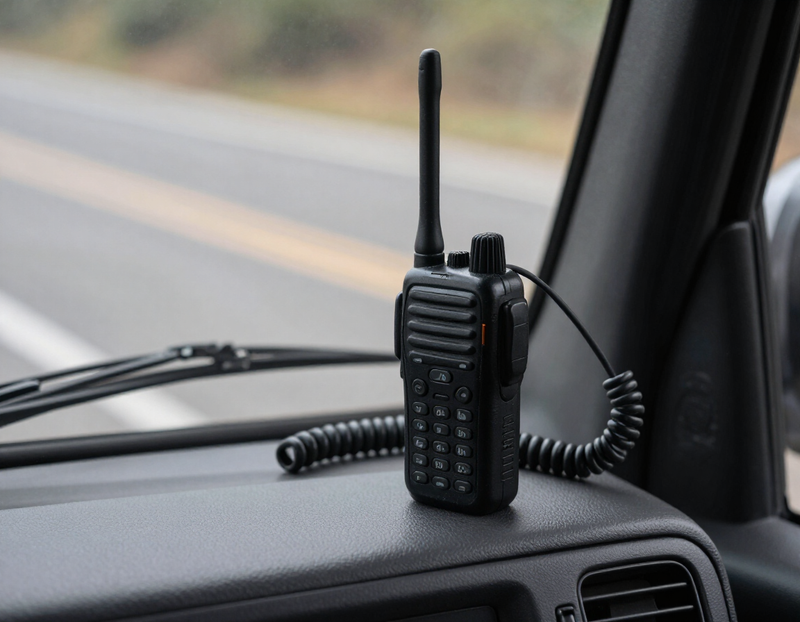
Mobile
Mounts in a vehicle with a roof antenna and 25 to 50 watts. The best way to use a repeater from the car.

Base station
A mobile radio at home with a power supply and an outdoor antenna. Strongest signal from a fixed spot.
See how it works
A quick illustrated look at the two ways to talk on GMRS in Cuyahoga Falls.
- 1Set your radio to 462.550 MHz with PL tone 141.3.
- 2Listen first to be sure the channel is clear.
- 3Press push-to-talk and give your call sign.
- 4Anyone in range hears you directly. Range depends on height and terrain.
- 1Set your radio to receive 462.675 and transmit 467.675, with PL tone 141.3.
- 2Press push-to-talk. Your signal goes up to the repeater on its tower.
- 3The repeater rebroadcasts it on 462.675 from its high site.
- 4Everyone in the area hears you, even far beyond what simplex reaches.
Simplex nodes
A simplex node is a small station that listens and talks on one frequency, with no repeater offset. Ours is on 462.550 MHz with PL tone 141.3.
- What it isA radio on one shared frequency with no repeater. Anyone in range hears you and you hear them.
- Our nodeCall sign WSFW755, operated by Josh in Cuyahoga Falls, Ohio.
- Our channel462.550 MHz, PL tone 141.3 Hz, narrowband FM.
- Why use itGreat for car-to-car, neighborhood chat and events, and it works when no repeater is in reach.
- Node versus repeaterA repeater retransmits on a second frequency from a high site. A simplex node transmits only on its own channel, so range is shorter but the setup is simple.
- Getting the best rangeGet high, get clear of buildings and trees, and use a better antenna. Low power is fine at close range.
- EtiquetteListen first, keep calls short, and give your call sign every 15 minutes and when you finish.
Building your own simplex node
- RadioA GMRS-capable radio set to 462.550 MHz with tone 141.3 Hz.
- AntennaAn outdoor antenna as high as possible with a good feedline is the biggest upgrade.
- Power supplyA steady 13.8 volt supply for a base radio, or a battery for a portable node.
- IdentificationA node must still identify with its call sign, WSFW755, at least every 15 minutes.
- PlacementClear of metal and trees, with a view over the area you want to cover.
Programming your radio
Six steps to get your radio on the WSFW755 repeater and simplex channel.
- 1
Get the right radio
Use a GMRS-capable radio that supports CTCSS tones and split frequencies, or the repeater will not open for you.
- 2
Pick your method
Type channels in by hand from the keypad, or use the radio maker's free programming software with a cable.
- 3
Save the repeater channel
Receive 462.675 MHz. Transmit 467.675 MHz. Set the transmit and receive tone to 141.3 Hz. Name it WSFW755.
- 4
Save the simplex channel
Receive and transmit 462.550 MHz with tone 141.3 Hz. Name it SIMPLEX.
- 5
Set bandwidth and power
Use narrow bandwidth (12.5 kHz). Start on low power and use high only when you need it.
- 6
Test it
Key up, say your call sign and ask for a radio check. If you hear a quick tail when you release, the repeater heard you.
If something is not working
- I hear nothing
- Check that you are on 462.675 and that the receive tone is 141.3. Turn the squelch down to hear if anything is there.
- The repeater does not open
- The transmit tone is probably missing or wrong. Confirm 467.675 transmit with 141.3 Hz.
- People hear me broken up
- Move to a higher, clearer spot and try high power. Check the antenna is tight and the right type.
- I only hear one side
- On simplex you only hear people near you. That is normal. Use the repeater for farther contacts.
Rules and regulations
GMRS is regulated by the FCC under Part 95. This is a friendly summary, not legal text. Read the official rules for the full picture.
- License
- You need an FCC GMRS license before you transmit. One license covers you and your immediate family. It lasts ten years and there is no exam.
- Identification
- Give your call sign at least every 15 minutes during a conversation and at the end of it.
- Power
- Up to 50 watts on the main 462 MHz channels. Several 462 MHz channels are limited to 5 watts, and the 467 MHz channels to half a watt.
- Repeaters
- Repeaters work on specific paired channels. Get the owner's permission and follow the repeater's rules before you use one.
- Equipment
- Use FCC-certified GMRS radios with FM voice. Do not use encryption or secret codes.
- Content
- Keep it clean. No profanity, obscenity, music or broadcasting, and no advertising.
- Emergencies
- Calls for help always come first. Clear the channel and help where you can.
- Penalties
- Breaking the rules can mean fines or losing your license, so keep within the limits.
Good habits
- A good antenna helps more than extra power. Higher and clearer of obstacles is better.
- Check that your radio is a GMRS radio that can store a tone. Some license-free radios cannot use repeaters.
- Use low power when you can. It saves battery and keeps the repeater clear for others.
- Listen before you talk, and leave a pause so someone can break in.
- Do a radio check on a net night. Say your call sign and ask how you sound.
Glossary
- Repeater
- A station on a tower that receives your signal on one frequency and retransmits it on another, extending your range.
- Simplex
- Direct radio-to-radio contact on one frequency, with no repeater.
- PL tone (CTCSS)
- A quiet sub-audible tone that opens a repeater or squelch. Ours is 141.3 Hz.
- Offset
- The gap between a repeater's transmit and receive frequencies. GMRS repeaters use 5 MHz.
- Net
- A scheduled on-air gathering with a host who takes check-ins.
- Call sign
- Your unique FCC-issued identifier, spoken to identify yourself.
- Squelch
- A filter that silences the speaker when nothing useful is being received.
- 73
- Radio shorthand for best regards.